The Postbox Has a Hat and Nobody Will Own Up: Britain’s Yarn-Bombing Underground
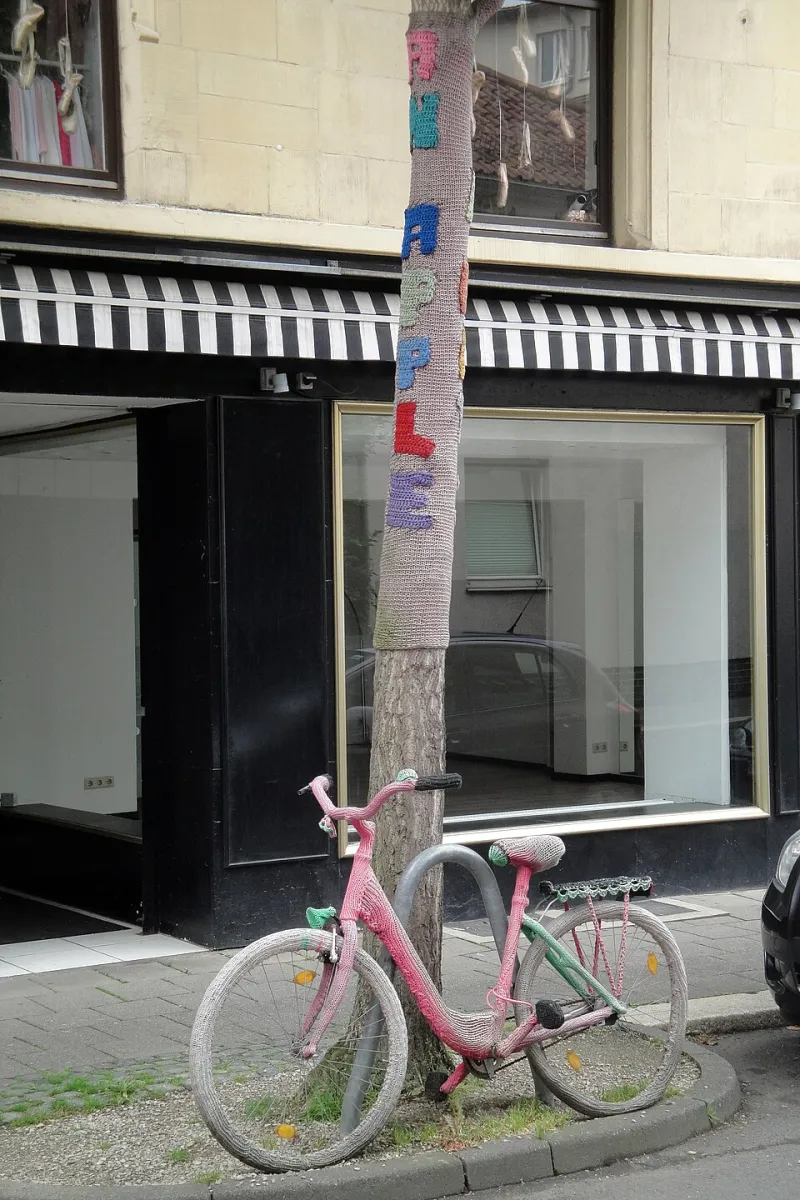
Photo: Reise Reise, CC BY-SA 4.0, via Wikimedia Commons
Somewhere in Britain right now, a traffic cone is wearing a tutu. It is not a metaphor. It is a real cone, presumably still doing cone business, but now with a ruffled wool skirt and a small, unbothered expression. Nobody knows who made the outfit. Nobody is rushing to claim it. And that, more or less, is the entire point.
Guerrilla knitting — yarn bombing, if you prefer the slightly more aggressive term — has been creeping across the UK for years. But in 2026 it feels less like a crafty fad and more like a quiet, woolly insurgency. Postboxes have hats. Bollards have scarves. Bus stops have small, unexplained pom-poms. A railing near you may be wearing a cardigan it did not ask for.
A cone, a cardigan and a code of silence
The appeal is not just the wool. It is the anonymity. Yarn bombers tend not to leave business cards. They do not post a press release. They stitch something slightly absurd onto a piece of public furniture and vanish, leaving behind a small local mystery and a photograph that will do numbers in the village Facebook group.
That silence is part of the etiquette. The work is meant to be spotted, not signed. It is a gift with no return address. In a world where every minor act of creativity is usually followed by a link in bio and a seven-part thread about the process, there is something genuinely refreshing about a person who spends three evenings knitting a tiny jumper for a bollard and then refuses to explain themselves.
It also makes the whole thing harder to police. A council can issue a statement about a person. It is much harder to issue a statement about a rumour.
From postbox toppers to full-body bollards
The gateway drug, for most British yarn bombers, is the postbox topper. You have seen them: the little knitted scenes perched on top of a red pillar box, usually celebrating a royal occasion, a local festival or the fact that it is Tuesday. They are cheerful, slightly wonky and often better attended than the actual event they are marking.
From there, ambition grows. A topper becomes a bollard cosy. A bollard cosy becomes a bus-stop banner. A bus-stop banner becomes a traffic cone in a tutu. The progression is not unlike a home baker starting with fairy cakes and ending up constructing a three-tier showstopper for the village fete, except the final product is attached to street furniture and may cause a brief health-and-safety meeting.
In 2026, the standard has risen. You will find knitted flowers wrapped around railings, tiny woolly books on library benches, and seasonal displays that appear overnight like a very wholesome form of graffiti. Some crews coordinate. Some work alone. Some likely just have a lot of spare wool and a strong opinion about the local roundabout.
The council email folder marked ‘woolly’
Here is where it gets interesting. Councils are not monoliths, and their responses to yarn bombing vary wildly. Some treat it as litter with a hobby. Others quietly adore it. A few have probably created a special email folder marked “woolly” and assigned it to the most patient person in the office.
The concerns are not entirely mad. Wool gets wet, fades and eventually droops. If it is wrapped around a sign, it can obscure information. If it is attached to a postbox, it might interfere with access. If it is on a traffic cone, someone has to decide whether the cone is still legally a cone. These are not glamorous debates, but they are very British ones.
Then there is the fire-risk conversation, which tends to arrive whenever someone wraps something around a railing near a bin. Most yarn bombers are careful. Most councils know they are careful. But “most” is doing a lot of work in a sentence that ends with a risk assessment.
Still, outright bans are rare. It is difficult to build a case against a small knitted fox when the same stretch of pavement has a pothole that has been reported since the mid-2000s. Councils have learned that removing a postbox topper can generate more local anger than a bin collection change. The topper is not the problem. The topper is the only thing on the high street that has clearly been cared for.
Why wool feels like rebellion in 2026
There is a reason yarn bombing lands differently now. It is slow, tactile and stubbornly analogue. You cannot scroll it. You have to walk past it. It exists in the real world, in the rain, on a street corner, for no measurable return on investment.
It is also a very gentle form of defiance. No one is blocking a road or chaining themselves to a lamppost. They are decorating the lamppost. The message, if there is one, is something like: this place is ours too, and we would like it to be a bit less grey.
That is not nothing. In a year when every public space seems to be either being regenerated, consulted on or quietly sold off, a knitted traffic cone is a tiny reminder that ordinary people can still alter the streetscape with a pair of needles and a bit of nerve. It is vandalism’s cosier cousin. It is a civic hug with plausible deniability.
The rules of the stitch (unofficial)
There is no central committee, but a few unwritten rules have emerged. Do not cover road signs. Do not wrap anything that needs to be seen in an emergency. Do not use wool that will bleed dye onto stone. Do not attach anything so tightly that it damages the paint. And, crucially, do not make it about you.
The best yarn bombs look like they have always been there. They blend into the street furniture like a small, woolly fact. They are not adverts for the maker. They are not content. They are just odd enough to make you stop, and just normal enough to make you wonder when the council started employing knitters.
If you spot one, don’t tug
The temptation, on finding a postbox wearing a tiny hat, is to check whether it is real. Resist. It is real. It is also someone’s evening. Leave it alone, take a photo, and let the mystery do its work.
Britain’s yarn bombers are not asking for a plaque. They are not asking for funding. They are asking, very quietly, for you to notice the street on your way past. In 2026, that might be the most wholesome rebellion we have left. A traffic cone in a tutu is not going to change the world. But it will make you look twice, and that is a start.