Exhibits Include a Bypass: Britain’s Tiny Shed Museums Are Having a Moment
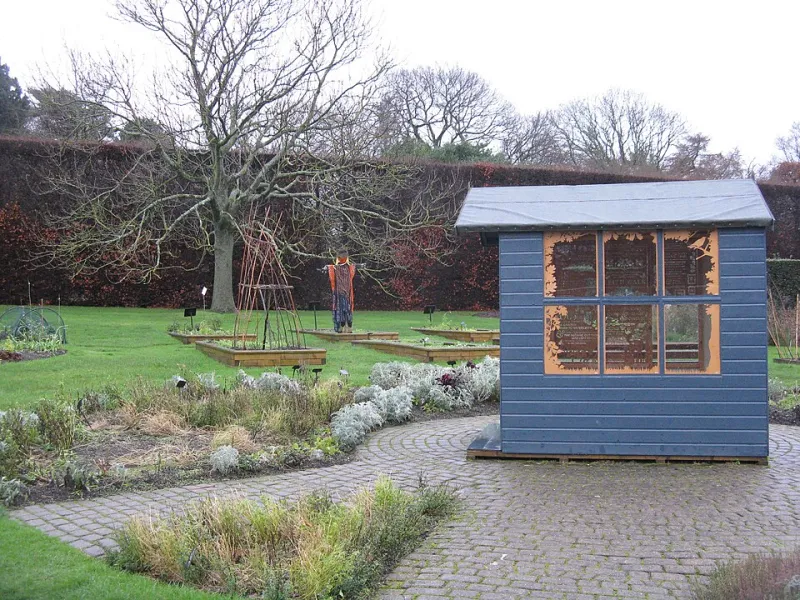
Photo: M J Richardson , CC BY-SA 2.0, via Wikimedia Commons
There is a particular kind of British afternoon that begins with someone saying, “It’s only three quid, and I’ve heard there’s a biscuit.” That sentence is currently powering a small but delightful boom in shed museums: private collections opened to the public in garages, summerhouses, spare rooms and converted coal sheds across the UK. They are not slick. They are not necessarily signposted. But they are specific, and in 2026, specificity is having a moment.
The curators are in the shed
You know the type. A retired engineer with 400 labelled tins. A woman who has spent 22 years collecting postcards of British piers before they were rebuilt, demolished or turned into a Wetherspoons. A man in Leicestershire who has built a scale model of the local bypass, complete with tiny traffic cones and one persistently misbehaving roundabout.
These are not formal museums. There is often no gift shop, unless you count a trestle table with some old guidebooks and a jar of 50p coins. There is frequently no loo. There is almost always a curator who will tell you, with genuine urgency, that the exhibit you are looking at is “the only one of its kind in the county, possibly the country, possibly the world, we’ve not checked.”
And that is the charm. The great national museums offer context, chronology and a carefully lit vase. The shed museum offers a person’s entire personality arranged on shelving units from B&Q, with a laminated label explaining why the 1974 pier postcard is the important one.
£3, exact change, and a biscuit
The pricing is part of the folklore. Three pounds is common. So is a sign that says “Adults £3, Children Free, Dogs Welcome If Calm.” Entry is often via an honour box: a Tupperware tub, a tin formerly containing shortbread, or a small wooden slot screwed to the wall with more care than the actual exhibits.
You put your money in. You feel briefly like you are trespassing, then briefly like you are part of a secret society, then briefly like you should have brought more change. The curator may appear, nod approvingly, and disappear again. This is the British transaction at its most trusting and its most awkward.
Then comes the biscuit. Not a fancy biscuit. A Custard Cream, a Bourbon, a Digestive if you’ve caught them on a health kick. It is offered on the way out, sometimes from a tin, sometimes from a plate, sometimes with the words “go on, take two, I’ve got a packet.” The biscuit is not the point. The biscuit is the whole point.
A bypass in miniature
The exhibits themselves are gloriously over-specific. One shed museum in the Midlands reportedly contains a working model of a bypass that took 11 years to build and can be operated by pressing a button marked “Rush Hour.” Another, on the coast, displays faded seaside postcards arranged by decade, with a special section for cards featuring people being hit by beach balls. A third, in a garage in Wales, is dedicated entirely to local bus timetables from 1968 to 1997.
This is not irony. Or rather, it is not only irony. There is real pride here. These collections are love letters to places that rarely get one: the roundabout that everyone complains about, the pier that burned down, the bus route that no longer runs but used to stop outside the chip shop. In a country where local news is often reduced to a Facebook group argument about bins, the shed museum is a quiet act of civic curation.
Why we can’t resist a hyper-specific exhibit
Part of the appeal is the antidote to the algorithm. You cannot scroll a shed museum. You have to stand in front of a cabinet of commemorative spoons and read a handwritten card about why the 1981 royal wedding spoon is “a bit controversial locally.” You have to ask a question and receive an answer that lasts nine minutes. It is slow, slightly damp and entirely human.
There is also the thrill of discovery. The best shed museums are not on Tripadvisor, or if they are, they have three reviews, one of which says “closed when we went” and another that says “lovely man, gave us a biscuit.” You find them through word of mouth, a leaflet in a café, or a sign at the end of a lane that says “MUSEUM” with an arrow pointing towards a greenhouse.
The biscuit economy
Let’s take the biscuit seriously for a moment. The honour box and the biscuit are a kind of social contract. You pay what you think it’s worth, and they give you something small and unnecessary to say thank you. It is not a transaction. It is a vibe. The biscuit says: we are not a business, we are a person with a shed and a story, and you are a person who turned up.
In 2026, when so much of culture is subscription-based, ticketed and aggressively branded, the shed museum feels almost radical. It asks for £3 and trust. It offers a bypass in miniature and a Custard Cream. It is, frankly, a bargain.
Local pride, one laminated label at a time
So next time you see a slightly wonky sign for a museum at the end of someone’s driveway, go in. Take exact change. Accept the biscuit. Ask about the bypass. The great British shed museum boom is not about nostalgia, not really. It is about curiosity, local pride and the belief that even a collection of faded postcards deserves a proper label, a Tupperware entry fee and a visitor who says, genuinely, “well, I never knew that.”
And if you’re thinking of opening one yourself, a word of advice: the biscuit matters more than the exhibit. Probably.