The Upright in the Waiting Room: How Britain’s Station Pianos Became Commuter Folk Heroes
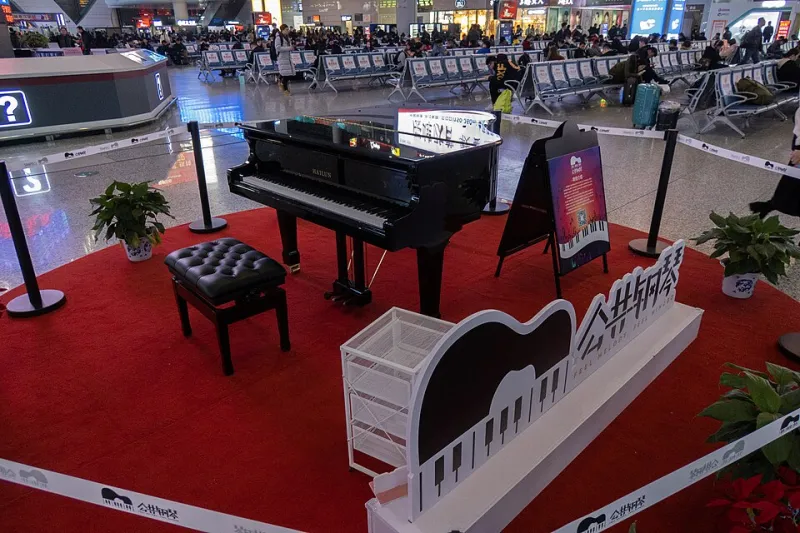
Photo: Siyuwj, CC BY-SA 4.0, via Wikimedia Commons
There is a particular kind of silence in a British train station. It is not peaceful. It is the sound of a hundred people pretending not to be annoyed. Then someone sits down at the piano and plays the opening bars of 'Clair de Lune' or, more often, 'Wonderwall'. The silence breaks. The commuters look up. For a moment, the 17:42 to Leeds is not a cancelled service. It is a concert venue with a draft.
Public pianos have been in stations for years, but 2026 is the year they became sacred. Not literally — although someone did leave a candle on one in Newcastle — but culturally. TikTok is full of station piano videos. There is a genre of clip where a tired-looking commuter starts playing and a crowd slowly gathers, phones out, faces soft. There is another genre where someone plays the same four notes for six minutes and a man in a suit visibly considers throwing himself under a trolley.
The concourse concert hall
St Pancras is the granddaddy of them all. The piano there has seen things. It has hosted impromptu jazz, a surprising number of Chopin requests and at least one person who played 'The Entertainer' with the confidence of a man who had never been told no. Leeds has a good one, tucked near the escalators, where the acoustics are surprisingly decent and the audience is mostly people waiting for a delayed Northern service.
Newcastle is the people's champion. The piano there has a slightly battered lid and a sign that says 'please play gently', which is either a request or a challenge. Norwich has a lovely one that seems to attract actual musicians. Birmingham New Street has one that is so centrally placed you cannot avoid hearing whoever is playing, which is wonderful when it is good and a test of character when it is not.
The unwritten rules of the keys
The etiquette is strange and deeply British. You can play for ten minutes. You can play for twenty if the crowd is into it. You cannot play 'Bohemian Rhapsody' unless you can actually play 'Bohemian Rhapsody'. You cannot sit down and just hit the keys while looking at your phone. You cannot bring sheet music for a song nobody knows and then act surprised when nobody claps.
The notes left on station pianos are their own genre of literature. 'Please do not play before 8am. Some of us are going to work.' 'If you are going to play Coldplay, at least play the good one.' 'To the man who played the same note for an hour on Tuesday: I hope your train is delayed.' The notes are passive-aggressive, but they are also evidence of care. Someone is guarding the piano. Someone has decided it matters.
A highly unscientific ranking
- St Pancras. Grand, dramatic, slightly too echoey, but it feels like a proper occasion. 2. Newcastle. Warm, scuffed, full of characters. 3. Leeds. Reliable, well-placed, good for a quick tune while you wait. 4. Norwich. The muso's choice. 5. Birmingham New Street. The most democratic — everyone hears you, whether they want to or not.
There are regulars who guard these pianos. One man in Leeds, who asked to be called Derek, says he has been playing the same station piano for six years. He has a favourite stool. He knows which keys stick. He has opinions about the acoustics. 'It's not about being good,' he says. 'It's about giving people a little moment. Even if the moment is them thinking, I wish he'd stop.'
When the 17:42 is cancelled
Can a battered upright fix a delayed Northern service? No. It cannot. The train is still late. The platform is still cold. The man next to you still has a bag on the seat. But the piano can change the mood. It can turn a concourse of sighing commuters into a room of people listening to the same thing. It can make a station feel less like a holding pen and more like a place where something might happen.
In 2026, that is worth something. We are not short of reasons to stare at our phones. We are short of reasons to stand still and listen. The station piano is a small, slightly out-of-tune reason. It is also, improbably, a folk hero. Long may it be played, gently, and long may the notes on the lid remain passive-aggressive and deeply British.