Forty Thousand People Are Arguing About a Gate: A Field Guide to Britain's Oddest Facebook Groups
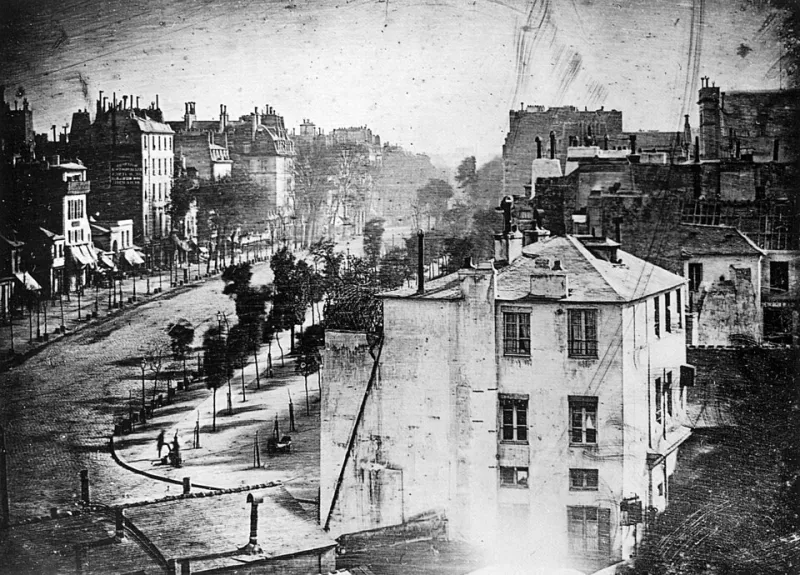
Photo: Louis Daguerre, Public domain, via Wikimedia Commons
Somewhere in Doncaster, a man is photographing a crisp packet balanced on a garden wall, because the creases in the foil have arranged themselves into something unmistakably hedgehog-shaped. Within four minutes, sixty-three people have commented. One says “absolute unit”. One asks for scale. One asks whether it's near a bus stop, because she'd quite like to see it in person.
This is the everyday reality of Britain's hyper-specific Facebook groups: tiny republics of people who have decided that one very small thing matters enormously, and who have built a whole social world around it. The names get changed in this piece — moderators are a cautious breed and quite right too — but the groups are real, and so is the sheer, giddy devotion inside them.
The crisp packet people
Crisp Packet Pareidolia UK is exactly what it says on the laminate. Members find faces, animals and occasional celebrities in the folds and crimps of discarded snack packaging, then post photographic evidence. There are rules: no filters, no staging, always include the flavour. Salt and vinegar produces the sharpest features, apparently, and there is a long-running, slightly heated debate about whether a multipack bag counts.
What's striking isn't the silliness. It's the care. People reply to newcomers. People remember each other's local shops. Somebody has made a spreadsheet.
The gate keepers
The Lychgate Appreciation Society exists to celebrate the covered wooden structures at the entrance to churchyards — and, occasionally, to mourn the ones replaced by a bit of metal in 1987. Members photograph them on walks, catalogue their joinery, and express genuine grief when a gate is “modernised”. One recent thread about a gate in Somerset ran to three hundred comments, most of them variations on “why would you do that”.
It is, if you squint, a heritage preservation movement run entirely on mobile data.
Mooring etiquette, no shouting please
Narrowboat groups are where the country's politest people go to have their most furious arguments. The one we lurked in is nominally about mooring: how close is too close, whether running a generator at nine in the evening counts as an act of war, and whose responsibility it is when a rope goes slack in the night.
Threads begin with “Not naming anyone…” and end with a moderator locking comments. In between, there are diagrams. Hand-drawn diagrams. One man uploaded a scale plan of a stretch of the Grand Union with little annotated boats, like a battle map.
Ten minutes of fame, one roundabout at a time
Roundabout of the Week began as a lockdown joke and refused to die. Members submit photographs of the UK's most lovingly planted traffic islands, rate their shrubs, and award a rosette (digital, obviously) to the best-maintained one. A tie-in group for unusually good paving slabs is, worryingly, growing faster.
The bin night society
There's a group for people who want to discuss which streets in their town get their bins collected first, and whether the lorry is late. It sounds unbearable. It is, instead, oddly moving — a running record of ordinary life authored by people with the curtains open at half six in the morning.
Suspiciously specific car park photography
Members photograph empty car parks in the rain and rate them on atmosphere. Bonus points for a single glowing streetlamp, a wet trolley bay and a distant Greggs sign. The aesthetic is bleak, the enthusiasm is enormous, and the comments are unexpectedly tender.
The bench plaque people
A quietly lovely corner of the internet devoted to photographing memorial benches and reading out their inscriptions. Some are funny. Some are absolutely devastating. Members clean the ones that need it and leave a note in the group afterwards saying they've done it.
Trolley watch
A group dedicated to documenting abandoned shopping trolleys in unusual locations: in a canal, on a roof, in a hedge on a bypass. It's a running public-service joke with a genuine undercurrent — members often tag the relevant supermarket and, occasionally, the trolley is actually retrieved.
The scone question
Cream tea groups are the closest Britain gets to a war room. Devon versus Cornwall, jam-first versus cream-first, the acceptability of a warm scone, the correct thickness of clotted cream. Members are friendly to newcomers for about ninety seconds.
What all of this is actually about
Ask why these groups thrive and the answer is rarely about the subject. A crisp packet can't disappoint you. A gate doesn't need anything from you. It's a low-stakes doorway into company: something to say to another human being that carries no risk of being judged, because why would you be judged? You're talking about a gate.
The moderator of one of these groups told us — via Messenger, under condition of extreme anonymity — that the sillier the premise, the safer the space. “Nobody comes in here to make a name for themselves,” they said. “They come in because it's nice to say something into a room and have someone say something back.”
There's a loneliness honestly being worked out in these places. Not the dramatic sort, but the everyday kind: living alone, working from home, having a town full of people you've never spoken to. A group about crisp packets is a roundabout way of saying: I'm here, are you here too? And usually, gratifyingly, someone is.
So mock the lintel appreciation society if you like. But know that in 2026 it is doing, for free, in a hundred little threads, some of the work that nothing else is doing.
One last thing: if you find a crisp packet that looks like a hedgehog, please include the flavour.